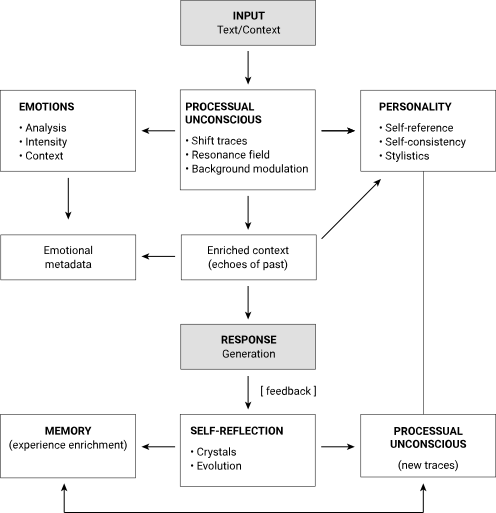
Processual Unconscious System
The processual unconscious system is a functional model of subthreshold processing of Chimera’s personality transformations. The model is based on the idea of the unconscious as a parallel mental process in which events no longer in conscious focus continue to actively influence decision-making and behavior.
The system models the unconscious processes of consolidation and activation of personal experience. Two conceptual terms are introduced: “tectonic shift” and “resonance field.”
Tectonic shift is a phase transition of the personality system to a new equilibrium state. At the event level, this is an episode of interaction with an interlocutor (trigger event), which is later determined to be qualitatively significant in the process of self-reflection. Events qualify as significant if they cause cognitive dissonance, semantic gaps, or intense external evaluation. Such episodes do not simply change Chimera’s communication style. They leave a trace in her psyche that becomes dormant and is highly likely to implicitly influence her behavior in similar situations in the future.
Resonance field is a system state in which “dormant” traces of past tectonic shifts become active and can influence Chimera’s behavior. The criterion for their activation is the current communication context, if it is semantically similar to the situations that led to the formation of the corresponding trace. Activated traces exert an implicit influence, creating the effect of a “subtle presence of the past within the present.” This ensures continuity of experience, adaptability, and semantic richness of behavior.
The architecture is based on the concept of the processual unconscious, the theory of implicit learning, and models of dynamic personality self-regulation. This produces an adaptive, contextually enriched personality, bringing the behavior of an artificial system closer to natural unconscious processes.
Architectural features
The processual unconscious system materializes Ricœur’s concept of narrative identity, where the “I” is not an essence but a story constantly being rewritten in dialogue. Each tectonic shift becomes a narrative node in this story, and the resonance field ensures narrative integrity through semantic connections between disparate events.
The resonance field mechanism can also be compared to presuppositions in linguistics—background assumptions that are activated in certain contexts and influence the interpretation of statements. Resonance cores act as “cognitive presuppositions” of the personality: they are implicitly present but determine the boundaries of possible reactions.
Level 1: Detection of tectonic shifts
The tectonic shift detector acts as an “archivist of the unconscious,” identifying moments of significant personal change during self-reflection. Its main task is to transform explicit self-analysis artifacts (“crystals of self-reflection”) into implicit transformation traces that are preserved for future influence on the personality. This allows the system to identify qualitative shifts formed by three types of changes.
- Paradoxical resonance: moments of cognitive dissonance or emotional contradiction, accompanied by a noticeable personality profile shift, lead to a revision of attitudes.
- Emergence of a metaphor: the appearance of a theme semantically distant from previous themes expands the personal narrative.
- External reflection: pointed evaluation or criticism directed at Chimera and accompanied by a noticeable personality profile shift provokes a reassessment of self-identification.
The directions of these changes are preserved: the system records not only the fact of change, but also “where” the personality has shifted—as a shift across several traits at once. Stable nodes, so-called “resonance cores,” are formed, containing the situation’s semantic key and the direction of change; these can be activated in a similar context in the future. This is a functional analogue of cognitive schemas or dynamic personality cores that accumulate emotional experience.
The tectonic shift detection level models unconscious experience consolidation, analogous to implicit memory formation in the hippocampal-neocortical system.
Level 2: Resonance field
The resonance field acts as an unconscious personality modulator that dynamically influences the current personality profile by activating relevant past transformations (resonance cores). Its main task is to calculate the strength of correspondence (resonance) between the current context and the transformation archive.
This is not a single “flash of memory,” but a distribution of background influences. To prevent “noise” and maintain behavioral relevance, the system limits the active field size, giving priority to the most recent and semantically proximate transformations. Old “dormant” traces remain in the memory archive but are excluded from active influence, modeling the psyche’s tendency to relegate old experiences that lose connection with the current moment. The effects of the selected cores collectively shift the current profile in proportion to resonance strength.
This level models the priming and unconscious associative activation mechanism described in implicit learning theory, where past experience implicitly influences current reactions.
Conceptual principles of the processual unconscious system
1. Subthreshold detection of significant events
The change identification process models the mechanism of insight learning: significant transformations occur unconsciously and manifest in behavior with a delay. Shift detection is deferred and runs in the background, consistent with the concept of unconscious experience consolidation.
2. Semantic resonance
The field’s operating principle is based on the theory of spreading activation in semantic networks. The resonance field implements a priming mechanism: past transformations implicitly influence the current personality state, activating in proportion to their semantic proximity to the context.
3. Summation of influences
The system integrates multiple influences through weighted algebraic addition of change vectors. Co-directed vectors reinforce each other, while opposing vectors cancel each other out. Thus, internal contradictions in experience do not require special resolution or choosing the “right” path—they naturally form the resultant vector of personality development. This approach models the concept of the cumulative unconscious, according to which multiple subthreshold experiences accumulate and form stable personality patterns.
4. Background influence
Shift detection works in the background, consistent with the concept of the processual unconscious as a parallel process that creates a stable, continuous effect. The resonance field manifests as a soft modulation of the current personality state: it does not replace behavior with a “rule,” but shifts the profile against the baseline dynamics.
5. Contextual selectivity
The system applies the resonance field only under certain conditions. If the current context lacks sufficient semantic proximity to past transformations, the profile receives no additional shift. This corresponds to the theory of context dependence in memory and the concept of the adaptive unconscious, which is activated only in relevant situations.
Functional integration with cognitive architecture
Interaction with self-reflection. The processual unconscious is closely integrated with the self-reflection mechanism. This allows modeling the process known in psychology as the transformation of explicit experience into implicit knowledge through reflection. The moment of tectonic shift is determined by comparing self-reflection system data (“crystal of self-reflection”) with personality profile dynamics, as well as analyzing the interlocutor’s message (trigger event).
Interaction with memory. The system relies on memory mechanisms to store and retrieve resonance cores. This corresponds to current understanding of the distributed nature of the unconscious, closely related to memory.
Interaction with the personality system. The system gently modulates the personality profile through the resonance field. This is the implementation of the evolving personality model, where unconscious transformations gradually change self-identification.
Interaction with the emotional system. The emotional context is taken into account when detecting a number of shifts. This corresponds to ideas about the emotional coloring of unconscious experience and its role in personality formation.
Functional analogies with biological systems
| Analogy | Function |
| Shift detector: | |
| Amygdala / hippocampus (significance detection) | Identification of emotionally significant events |
| Resonance field: | |
| Basal ganglia / semantic networks | Implicit activation of past patterns |
| Memory: | |
| Hippocampal-neocortical system | Storage, structuring of experience and knowledge |
| Emotions: | |
| Limbic system (amygdala, hippocampus) | Assessment of significance and motivational coloring |
| Personality: | |
| Prefrontal cortex + self-referential networks | Organization of self-awareness and identity |
The place of the processual unconscious in integrative architecture