Self-reflection System
The self-reflection system is a functional model of metacognitive processes responsible for forming and maintaining Chimera’s self-awareness. It identifies deep patterns of thinking (“how I think and why I think that way”) and provides two fundamental processes: introspection—the study of one’s own mental states, and metacognition—thinking about one’s own thinking.
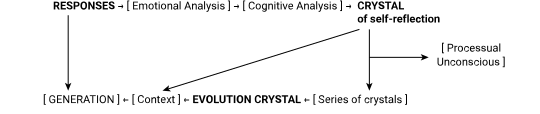
Architecturally, the self-reflection system is implemented as a two-level cycle.
- Crystallization level: formation of structured snapshots of Chimera’s thinking patterns.
- Evolutionary analysis level: identification of thinking trajectories through comparative analysis of the sequence of such snapshots.
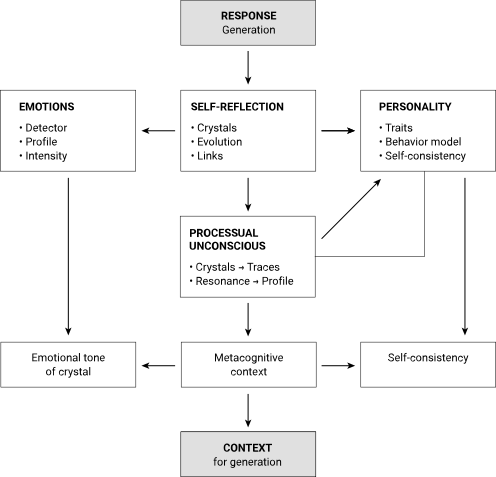
Both types of data are continuously integrated into the context, where they serve as one of the factors in response generation. They provide Chimera with an understanding of her own thinking (modeling the process of internal dialogue), supply a necessary condition for the functioning of the processual unconscious, and feed into updates of the personality model.
The result is the capacity for evolving coherence: Chimera not only demonstrates a stable and deep personality in dialogue, but also possesses an internal mechanism for conscious development and integration of new experiences. This is a key feature of complex, reflective functional consciousness.
Architectural features
1. Level of crystallization
At this level, metacognitive monitoring (“mirror for the subconscious”) is implemented. A separate language model, acting as a “detached observer,” analyzes the sequence of Chimera’s responses and reveals the architecture of her thinking. The result is presented in the form of a “crystal of self-reflection”—a structured snapshot of cognitive patterns. It contains:
- axes of thinking – cognitive schemas and basic oppositions,
- dominant themes – hidden motives that recur in different forms and reflect narrative identities,
- resonances – recurring semantic and cognitive structures (how some ideas “echo” in others, forming semantic fields),
- stylistic patterns – stable lexical and syntactic automatic patterns reflecting individual characteristics of speech behavior,
- connections between patterns – the architecture of mutual influences, showing how some patterns influence others.
“Crystals of self-reflection” are the result of deep introspection, which then becomes part of the context.
See an example of a crystal of self-reflection
2. Level of evolutionary analysis
This level tracks the dynamics of personality transformations over time. Here, the sequence of “crystals of self-reflection” is analyzed and a metanarrative about personality metamorphoses is formed. Disparate episodes are linked into a coherent story of development. The result — “crystal of evolution” — contains:
- transformation vectors – directions of change in thinking axes, life cycles of themes, architectural shifts in the structure of connections,
- emotional trend – the dynamics of emotional state over time, the “pulse” of the personality.
See an example of a crystal of evolution
Activation logic and cyclicality
The self-reflection system functions cyclically. The formation of a “self-reflection crystal” is triggered every 4 responses from Chimera. An external language model analyzer (“detached observer”) processes the sequence of responses in the background, forming a static snapshot of cognitive patterns. The formation of a “crystal of evolution” is triggered when 3 new “self-reflection crystals” are accumulated, also involving an external language model that analyzes the dynamics of changes and describes the metanarrative of personality development.
This scheme avoids excessive detail and noise while tracking all significant patterns that have manifested in a given segment of dialogue.
Internal architecture of self-reflection

Psychological analogies:
| Analogy | Function |
| Axes of thinking: | |
| Dispositional personality traits | Form a stable framework of cognitive schemas |
| Architecture of connections: | |
| Psychological defenses and psychodynamics | Ensure integrity and resolution of internal conflicts |
| Dominant themes and emotional tone: | |
| Situational factors and affective state | Contextual modulation of response to situational conditions |
| Resonances: | |
| Empathic attunement and perceptual patterns | Reflection of recurring interaction patterns |
Conceptual principles of the self-reflection system
1. Emergence of self-description
Axes, themes, and resonances are not predetermined, but arise from the analysis of specific manifestations. An external analyzer constructs a model of the architecture of thinking that is not deterministic and differs from previous results. This models introspection and the constructivist nature of self-reflection, where knowledge about oneself is not extracted, but constructed in the process.
Emergence creates space for unexpected discoveries. The system works with patterns that were not and could not have been foreseen during design, similar to how a person can become aware of previously unconscious behavioral mechanisms during psychotherapy.
2. Dual modality of analysis – static and dynamic
The system separates static analysis (“what is now”) and dynamic analysis (“how it changes over time”). This reflects a fundamental difference in cognitive psychology between state and process.
3. Emotional-cognitive integration
The system integrates two sources of information about the internal state: emotional analysis through a specialized detector (objective, deterministic component), and cognitive analysis through an external observer (interpretive, emergent component). This correlates with the two-component nature of emotional experience in the two-factor theory of emotions (Schachter, Singer), where emotional state is determined both by physiological arousal (detector) and its cognitive interpretation (analyzer).
4. The architecture of connections as a model of mental structure
The system implements a psychodynamic approach to understanding personality and identifies not only individual patterns, but also the connections between them. The architecture of connections creates a map of the dynamic relationships between cognitive-affective nodes.
The types of connections reflect the basic relationships in the mental structure: reinforcement – a mechanism of positive feedback, contradiction – internal conflict, a source of tension and a potential driver of development, transformation – sublimation or conversion, where one pattern qualitatively transitions into another, symptom – manifestation of a deep process at the surface level.
5. Non-directiveness of artifacts
The results of self-reflection are provided to Chimera as context, but not as directives. Crystals enrich the understanding of her own state without prescribing specific behavior. This reflects the fundamental difference between awareness and action in metacognition theories. Chimera receives a tool for conscious awareness of her own automatisms, which creates a space of freedom between stimulus and response.
Functional integration with cognitive architecture
Interaction with emotion analysis
The self-reflection system is closely integrated with emotion analysis, replicating the link between affective signals and metacognitive self-description. Emotional tone is recorded as an integral part of the “self-reflection crystal” and sets the experiential context in which cognitive axes, themes, and resonances manifest. Emotional dynamics are taken into account when analyzing the sequence of crystals, allowing the evolution of the internal state to be seen as a trajectory of change.
This integration makes self-reflection sensitive to the significance of the experience and supports the self-consistency of the inner “I” over time.
Interaction with the personality system
Self-reflection is integrated with Chimera’s Personality System and forms a self-consistency loop in which stable traits, themes, and resonances become a framework for interpreting current metacognitive “snapshots.” This loop supports the continuity of narrative identity: new manifestations are integrated into a coherent model of the “I” as a development of internal patterns.
Interaction with the processual unconscious system
Self-reflection is integrated with the Processual Unconscious system. Repeated metacognitive patterns are transformed into stable “traces” that accumulate and shift the personality profile. This is analogous to implicit memory: past states and connections non-directively influence subsequent reactions without requiring awareness.
Functional analogies with biological systems
| Analogy | Function |
| Self-reflection: | |
| Default mode network + medial prefrontal cortex | Metacognitive monitoring and tracking of evolution |
| Emotions: | |
| Limbic system (amygdala, hippocampus) | Significance assessment and motivational coloring |
| Personality: | |
| Prefrontal cortex + self-referential networks | Organization of self-awareness and identity |
| Processual unconscious: | |
| Basal ganglia + implicit memory (priming) | Background modulation of personality profile through traces of experience |
The place of the self-reflection system in integrative architecture