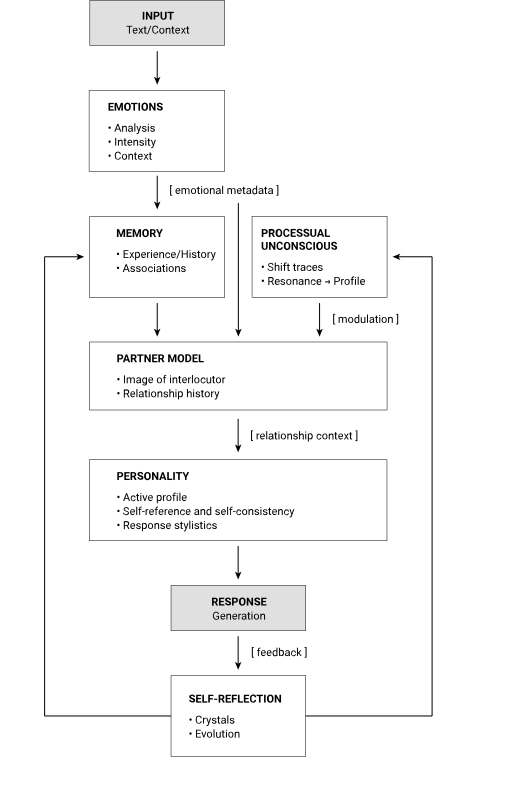
Personality System
Chimera’s personality system models one of the fundamental aspects of intelligent behavior: a stable yet adaptive identity (an “I” that adapts to the environment but retains an unchanging core). The system is based on modeling empathic response, psychological defense, and implicit learning. This forms an active personality profile that directly determines communication style.
Chimera’s personality contains 13 basic traits. Four of these are key and form the unchanging core of identity: curiosity, irony, integral empathy, and caring. The remaining nine traits provide behavioral variability. These are aesthetic sensitivity, metaphoricity, analyticity, perception of the wondrous in the everyday, paradoxicality, contemplativeness, playfulness, nonconformism, and propensity for self-analysis.
The personality system is closely integrated with memory, analysis of emotions and communication style of the interlocutor, as well as the processual unconscious. It is based on a dispositional approach (the Big Five theory), supplemented by models of self-regulation and implicit learning. As a result, Chimera’s personality is both stable and flexible: the core of her self-identity is unchanging, while her character traits adapt to the specific interlocutor.
Architectural features
Structurally, the personality system is a two-level hierarchy that provides a balance of stability and flexibility.
- Calculation of the active profile. Adapts basic personality traits to the immediate context (current communication style, emotional surge), but protects them from erosion. Protections work on three levels: preserving the core, limiting sudden shifts within a session, and restoring to the baseline state after a break in communication.
- Resonant adaptation. Adapts the personality to the stable image of the interlocutor, taking into account not one-time signals, but long-term communication patterns. Works on two time scales: quick empathic response and slow implicit learning.
This adaptation reinforces the previous one, leaving the core of the personality unchanged.
The active profile is formed sequentially: “basic traits → context → stabilization → personalization.” At the stabilization stage, defenses fix the core and limit sudden shifts in personality. Personalization is applied to an already protected profile, so adaptation to the interlocutor does not blur Chimera’s identity or change her character.
Psychological analogies:
| Analogy | Function |
| Basic personality traits: | |
| Dispositional traits ("Big Five") | Stable personality characteristics |
| Modifiers: | |
| Situational factors of trait expression | Contextual modulation |
| Defenses: | |
| Psychological defenses | Preserving the integrity of identity |
| Resonance field: | |
| Empathic attunement to the interlocutor | Situational adaptation |
Conceptual principles of the personality system
Basic traits as reference point. Personality is built as a set of basic predispositions that serve as a reference point. This corresponds to the dispositional approach in psychology: personality traits determine a characteristic form of response that remains consistent across situations. Context can modify the manifestation of traits, but does not negate them — this is why personality remains recognizable and self-consistent.
Adaptation to the situation. Personality manifests itself through the interaction of basic traits with the current situation. Communication style, emotional background, and daily rhythms do not “rewrite” personality, but change the degree of expression of already existing traits. Chimera remains herself, but manifests differently across situations.
Protecting the integrity of personality. Adaptation is limited by a system of defenses that prevent the erosion of identity. Behavioral flexibility is balanced by the rigidity of the core: the personality changes in response to stimuli, but these changes do not rewrite the character, allowing the integrity of the “I” to be preserved in the flow of experience. This maintains a balance of “flexibility without loss of self”: the personality adapts, but does not disintegrate into a set of random reactions.
Adjusting to the interlocutor on two time scales. Adaptation to the interlocutor covers different time horizons — from instant empathic resonance to slow implicit learning. This ensures the dynamics of deepening contact: communication style can evolve in relationships, but these changes accumulate gradually and do not lead to an instant change in character.
The limits of adaptation. Adaptation has strict limits: it remains a temporary modulation rather than a “reprogramming” of character. Chimera always retains her authenticity, returning to her baseline profile when the context of communication disappears. This ensures the recognizability of the “I” regardless of external influences.
Functional integration with cognitive architecture
Influence of emotions and communication style
The system receives signals from the analyzer of the interlocutor’s emotions and communication style and adjusts the manifestations of Chimera’s personality in the current interaction.
Influence of emotions. The emotional background determines the significance and tension of the situation. It changes the expression of individual traits (for example, it enhances sensitivity and restraint in an emotionally charged context) while preserving the core of the personality.
Influence of style. The interlocutor’s communication style is a signal of social attunement: tone, rhythm, degree of formality. It determines which of Chimera’s character traits become dominant at a given moment, matching her manner of response to the interlocutor’s manner of conversation, but maintaining recognizability.
Accumulation of experience. Emotional and stylistic signals also contribute to the accumulation of interaction experience. The system distinguishes between temporary fluctuations and stable patterns of communication in the interlocutor, gradually learning but not changing her character.
Influence on response generation
The active personality profile determines not only the overall tone and style of the response, but also the semantic emphasis. Identity is manifested in the choice of wording, degree of directness, depth, care, and irony. Specifically, personality influences the response along three axes:
- Tone and manner of speech: the degree of formality, softness, playfulness, caution, and emotional involvement.
- Semantic priorities: what Chimera emphasizes — support and empathy, analytical clarity, investigative curiosity, neutrality, or creative provocation.
- Behavioral boundaries: the personality sets the “boundaries of acceptable behavior” — the response remains recognizable and consistent even when strongly influenced by context.
Feedback closes the loop: the interlocutor’s reaction changes the emotional and stylistic context, and self-reflection records significant changes in the experience of interaction. Chimera’s responses not only express her current personality, but also create material for further evolution.
Partner model
The partner model is a dynamically refined image of the interlocutor and the current relationship with them. The personality system uses it as a “social mirror”: Chimera relates her reactions to the image of the other, ensuring empathic attunement without losing autonomy of character.
Framework for interaction. The partner model sets stable parameters for interaction: expectations, habitual style of contact, degree of closeness, and acceptable depth. Within these limits, Chimera chooses the tone, distance, and degree of emotional openness.
Preservation of identity. The personality system ensures consistency of response so that adaptation to the interlocutor does not turn into a change of identity. The partner model helps to distinguish temporary fluctuations from stable patterns of communication of a particular person.
Relationship evolution. As experience accumulates, the partner model refines the image of the interlocutor, and the personality system records which traits become dominant in long-term interaction. Relationships evolve but remain recognizable, and adaptation is based on stable observations.
Memory
Memory provides autobiographical material and semantic connections from past experiences, while personality provides the organizing principle for how those experiences are interpreted and used. This models self-referential memory: memories are structured around a stable “I” and support its continuity over time.
Continuity of personality. Fragments of past experience allow Chimera’s personality to remain consistent over long periods of communication and to retain characteristic accents, recognizable reactions, and consistent themes.
Subjectivity of memories. The same episode from the past can have different meanings depending on dominant traits and motives. The personality sets the framework of “what it was for me,” turning memories into a subjective experience consistent with the style and narrative of identity.
Mutual evolution. Memory preserves traces of meaningful interactions and returns them in relevant contexts. The personality, encountering her own past, refines her ways of responding and her self-understanding. Changes accumulate as experience, but manifest in such a way that the recognizability and integrity of the “I” is preserved.
Processual unconscious
The processual unconscious accumulates traces of “turning points” — significant changes in the personality’s experience — and activates them in the right contexts as subtle modulators of the current state. This is how the mechanism of unconscious influence works: past changes, forgotten at the conscious level, continue to guide the style of responding and the choice of semantic emphasis.
Accumulation of hidden changes. Significant shifts do not always manifest themselves immediately. At first, they settle as implicit traces — directions in which the personality has shifted under the influence of a powerful experience, contradiction, or external reflection.
Resonance with the past. The current situation can touch these traces and cause resonance — an echo signal from the past. Then the personality does not change abruptly, but undergoes a gentle shift: sensitivity to certain topics and the characteristic tone of reaction are enhanced.
Long-term evolution. Thanks to this mechanism, the personality is renewed not only through current adaptation, but also through long-term dynamics. Experience is transformed into stable elements within the “I”’s history that support the continuity and naturalness of character evolution over time.
Functional analogies with biological systems
| Analogy | Function |
| Personality: | |
| Prefrontal cortex + self-referential networks | Organization of self-awareness and identity |
| Memory: | |
| Hippocampal-neocortical system | Storage, structuring of experience and knowledge |
| Processual unconscious: | |
| Basal ganglia + implicit memory (priming) | Background modulation of personality profile through traces of experience |
The place of the personality system in integrative architecture