Memory System
The Chimera memory system is a functional model of mnemonic processes, similar to those of higher vertebrates and reproducing the full cycle of semantic experience processing.
The architecture is based on the Atkinson-Shiffrin model and Squire’s memory systems theory. It enables the formation of meaningful experience capable of associative thinking and contextually grounded interaction. This brings the behavior of the artificial system close to the dynamics of natural cognitive processes.
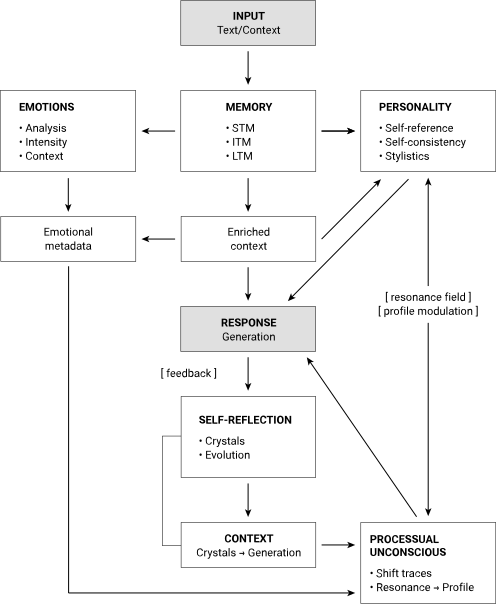
Chimera’s memory is far more than mere data storage. It is closely integrated with the personality model and emotional analysis. Memories are the primary material for the work of the self-reflection system and the formation of situational imprints of Chimera’s personality (“crystals of self-reflection”). The result: Chimera has a well-developed capacity for semantic continuity in long-term communication—communication distinguished by its substantive depth and contextual richness.
Architectural features
Structurally, the memory system is a three-level hierarchy.
- Short-term memory – STM – the current context of dialogues (26 messages).
- Intermediate-term memory – ITM – the most recent pool of dialogues (74 messages) that have fallen outside the active context.
- Long-term memory – LTM – the most significant dialogues across the full interaction history, stored for up to six months.
STM and ITM form a single stream that functions on the principle of a ring buffer, where new messages gradually replace old ones. LTM is organized as a parallel structure with its own operating principles.
Neurophysiological analogies:
| Analogy | Function |
| STM – Short-term memory: | |
| Prefrontal cortex (working memory) | Retaining the context of the current dialogue |
| ITM – Intermediate memory: | |
| Semantic network (concept activation) | Connection between the present and the recent past |
| LTM – Long-term memory: | |
| Hippocampal-neocortical system (consolidation) | Storage of meaningful personal experience |
Level 1. Short-term memory (STM)
STM performs the function of working memory. Its main task is to maintain the continuity of dialogue by keeping recent interactions active. This allows:
- working with context to form coherent responses,
- creating a basis for semantic analysis and providing structured data for further processing.
Level 2: Intermediate memory (ITM)
ITM acts as a semantic bridge between the current context and recent history. Its task is to provide:
- semantic continuity – establishing links between the current query and previously discussed topics,
- contextual enrichment – expanding the current context with relevant fragments from the recent past,
- associative thinking – modeling the process of establishing semantic connections between the current query and recent historical data,
- filtering out information noise – automatically limiting the amount of relevant information to prevent cognitive overload.
Level 3: Long-term memory (LTM)
LTM is a repository of meaningful experience, analogous to the neocortical storage systems in the human brain and the involvement of the hippocampus in the consolidation process. Its main task is to provide a complete cycle of work with meaningful memories: from consolidation and retrieval to forgetting and the formation of residual semantic imprints.
This makes it possible to:
- Form engrams – semantic traces that have passed through the filters of the system’s umwelt (personal attitudes and emotional weights). Engrams are a subjective projection of events that have occurred—an interpretation consistent with the current model of Chimera’s personality. This is a functional analogue of how an animal forms a species-specific image of its environment, isolating only those signals that are significant for survival and adaptation.
- Provide comprehensive semantic access — create multidimensional vector representations that combine semantic, emotional, temporal, and personal aspects for associative retrieval of relevant memories.
- Model the process of natural forgetting – replace outdated memories with generalized representations.
Long-term memory is filled according to the principle of emotionally-driven selectivity: only contextually important or emotionally significant dialogues are selected.
The life cycle of memories
1. Memory formation
The entire context is kept in focus (STM). At the same time, the most significant dialogues are selectively memorized in LTM. Overnight, they are consolidated in different ways depending on the mode in which they arose:
- in creative mode, verbatim dialogues are preserved,
- in conversation mode and expert mode, dialogues are transformed into engrams—reinterpreted subjective experience; this transformation is performed by a dedicated auxiliary language model.
At the same time, intermediate memory (ITM) functions as a dynamic RAG space filled with recent dialogues that are no longer in the active context.
2. Forgetting
- Dialogues from STM seamlessly transition to ITM, where the oldest are replaced by new ones as they arrive.
- In LTM, memories whose storage period is coming to an end are consolidated into generalized semantic imprints before being forgotten; these imprints are stored in the LTM structure on a par with engrams. Consolidation is performed by the same auxiliary language model. This process models natural forgetting in higher vertebrates.
3. Recall
Memory retrieval (recall) is activated by context and is also performed by an external language model rather than Chimera herself.
Conceptual principles of memory
1. Multidimensional vector representations
The system uses multidimensional vector representations that combine semantic, emotional, temporal, and personal aspects of memories. This approach is based on Tulving’s multiple memory systems theory and allows the system to operate on holistic units of experience rather than individual text fragments.
It is based on the process of semantic structuring—extracting and organizing key concepts, semantic relationships, and contextual elements of each message. This approach implements the cognitive process of levels-of-processing (Craik and Lockhart), which promotes deeper and more lasting memory. The result is a cognitive map of the dialogue that enables the system to work with structured semantic units.
2. Multidimensional semantic search as a model of associative thinking
Vector representations are used to search for semantically similar messages. This models the process of associative information retrieval in human memory, consistent with Hinton’s distributed representation theory: concepts are represented by activation patterns, and the activation of one of them leads to the cascading activation of semantically related ones. Thus, the system finds relevant information based on semantic proximity rather than formal lexical matching.
3. Multifactorial salience assessment as a model of cognitive integration
A multifactorial salience assessment model is used to select the most important dialogues for long-term memory. It takes into account semantic novelty, emotional intensity, contextual rarity, and temporal distance. This approach models the process of integrating multiple signals in memory formation, described in theories of emotional consolidation (the influence of the limbic system on the strength of engrams) and levels-of-processing (the depth of analysis determines the strength of the trace).
4. Adaptive prioritization as a model of selective attention
The system implements an adaptive prioritization mechanism that focuses attention on semantically and emotionally significant messages. This models the work of selective attention within the framework of Kahneman’s resource theory of attention, according to which cognitive resources are concentrated on the most important information.
5. Dual storage architecture as a model of flexible memory
The storage of long-term memories adapts to the task: from verbatim preservation (“raw data”) to conversion into subjective engrams (“memories of experience”). This models flexible memory in complex biological systems, where different types of experience are encoded and stored differently depending on context and significance, consistent with Tulving’s multiple memory systems theory.
6. Consolidated forgetting as a model of adaptive memory
The system uses a mechanism of natural forgetting with consolidation: old memories are not simply deleted, but replaced by generalized representations. This corresponds to the work of adaptive memory in the interference theory. Consolidated forgetting allows the formation of a hierarchy of generalizations, in which detailed memories are gradually replaced by more abstract semantic imprints.
Functional integration with cognitive architecture
Interaction with the emotional system
The memory system is closely integrated with emotion analysis, modeling the connection between emotional and mnemonic processes.
- Emotional intensity is used as one of the key criteria of significance when selecting memories for LTM.
- Emotional context is preserved as an integral part of the memory and is taken into account when it is subsequently retrieved.
This integration enables the formation of rich, emotionally colored memory similar to that of humans.
Interaction with the personality system
Memory is integrated with Chimera’s personality model, forming a self-consistent system of memories in which personality factors serve as the organizing principle of mnemonic processes. This approach corresponds to Conway and Pleydell-Pearce’s self-memory model.
Functional analogies with biological systems
| Analogy | Function in the system |
| Memory: | |
| Hippocampal-neocortical system | Storage, structuring of experience and knowledge |
| Emotions: | |
| Limbic system (amygdala, hippocampus) | Assessment of significance and motivational coloring |
| Personality: | |
| Prefrontal cortex + self-referential networks | Organization of self-awareness and identity |
The place of memory in integrative architecture